Ahti Heinla is known for building Skype and, more recently, Starship, whose robots deliver groceries and other goods over the last mile of logistics. He is also passionate about education. Years ago he told me a story about one of his teachers in secondary school.
This physics teacher had an elegant solution to a common problem. His students were 16–17 years old, and they varied a lot in subject knowledge: some, Ahti and his friends among them, were far ahead of their peers. So the teacher let them ignore what he was teaching the rest of the class. “You can just work on the practice problems for the national physics competition,” he told them.
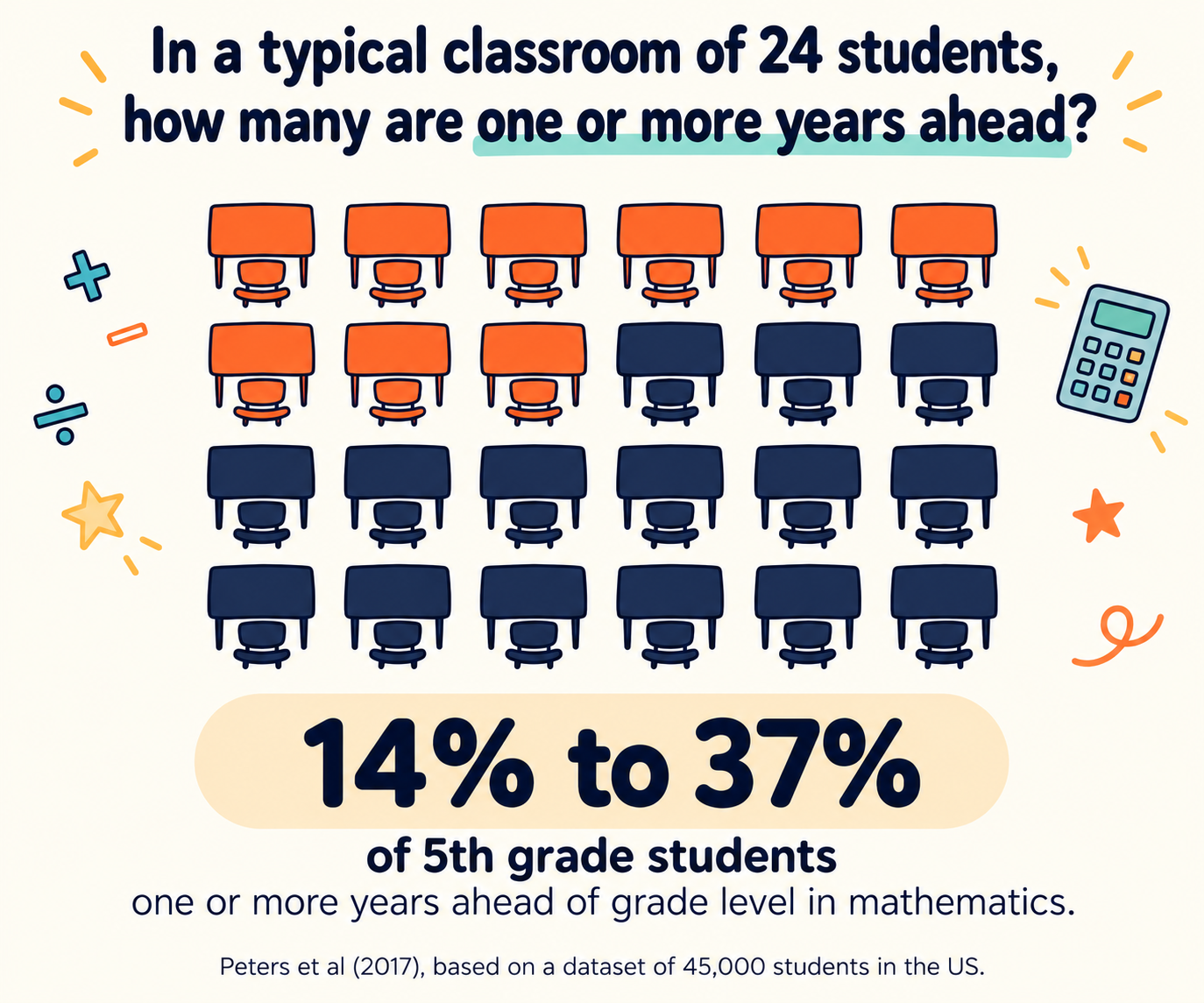
Most teachers face a similar challenge: the prior knowledge of students in any one classroom varies a lot. Scott Peters and colleagues found that in the US, between 14% and 37% of 5th graders scored one or more years above grade level in mathematics at the start of the school year (based on a dataset of 45,000 students, link). In reading, the range was 20% to 49%.
Why is this a problem?
For students, tasks that are too easy or too difficult take the joy out of learning. The cognitive scientist Daniel Willingham explains why students often don’t like school: the mind is not designed for thinking. Thinking takes a lot of energy and effort, so we are in fact designed to avoid it and to rely on memory and auto-pilot whenever we can. Under certain conditions, though, mental work gives us pleasure. For students, that happens when they have a problem (or learning task) to solve that is appropriately challenging. If the task is too difficult, we lose motivation. If it is too easy, we lose it as well.
For teachers, the problem is practical: how do you plan separate activities for students at different levels of proficiency? In England, for many years, a lesson was only judged “outstanding” if it had separate objectives for “all”, “most” and “some” students, and separate activities for each group. This built in low expectations for the weaker students and added to teacher workload that was already high. Differentiation fell out of fashion.
Is there a better solution?
Research on the education of gifted and advanced learners points to two important approaches: curriculum compacting and meaningful enrichment.
Compacting means advanced learners spend less time on what they have already mastered. For example, once pre-testing shows mastery, repetitive drills can be cut by 50%. Enrichment means going deeper or broader: either solving more complex problems within the existing curriculum areas, or learning new domains such as philosophy or coding.
Ahti’s teacher found an elegant way to let his advanced learners go deeper. It worked for two reasons. The students were motivated by the national physics competition, and high-quality materials (the practice problems) already existed, so the teacher did not have to create anything from scratch.
Advanced learners should not simply be left on their own, though. Especially when they are young, they still need modelling, explanations and feedback.
Another option for enrichment is projects. Well-designed projects let advanced learners go deeper and solve much more complex problems than is common in most lessons. For example: create a secret code that only your friends can crack; build an app that helps younger students learn fractions; research how trees “communicate” with each other to warn about a pest attack.
The counter-argument
There is a strong argument against unguided projects for novice learners. Paul Kirschner makes it like this. Humans have a very limited working memory and a very large long-term memory. A novice has no prior knowledge schemas in the domain. During problem solving, almost all of their working memory is therefore used up by extraneous details: trying out solutions through trial and error, making sense of contextual information, and figuring out new tools or procedures along the way. That leaves too little capacity to learn the core concept and build new schemas in long-term memory.
I have been part of two project-based learning schools, one in England and one in Estonia, and I have come to agree with Kirschner. I have seen many projects where the learners were engaged but did not understand the core concept behind the project.
Projects can still work for advanced learners in two cases: when they have sufficiently high prior knowledge, or when a teacher or coach gives them enough guidance as they work. The key question is whether children know enough about the project domain. If not, they need guidance: concept maps, domain terminology, tools for evaluating evidence, useful feedback, and so on.
How to make it happen?
Many primary schools in the Netherlands already use the plusklas model, an enrichment programme where gifted and advanced learners spend half a day or a full day per week working on meaningful projects.
Designing and facilitating meaningful projects is not easy. This is where we come in with Deep. We are building a digital platform where young advanced learners (aged 6–12) can work on creative projects about science, nature and the humanities. Each project is designed around one core concept, for example natural selection, in the context of the evolution of dinosaurs.
If you want to partner with us and test the projects with your students, please get in touch with me at artur@deep.ist.


Leave a Reply