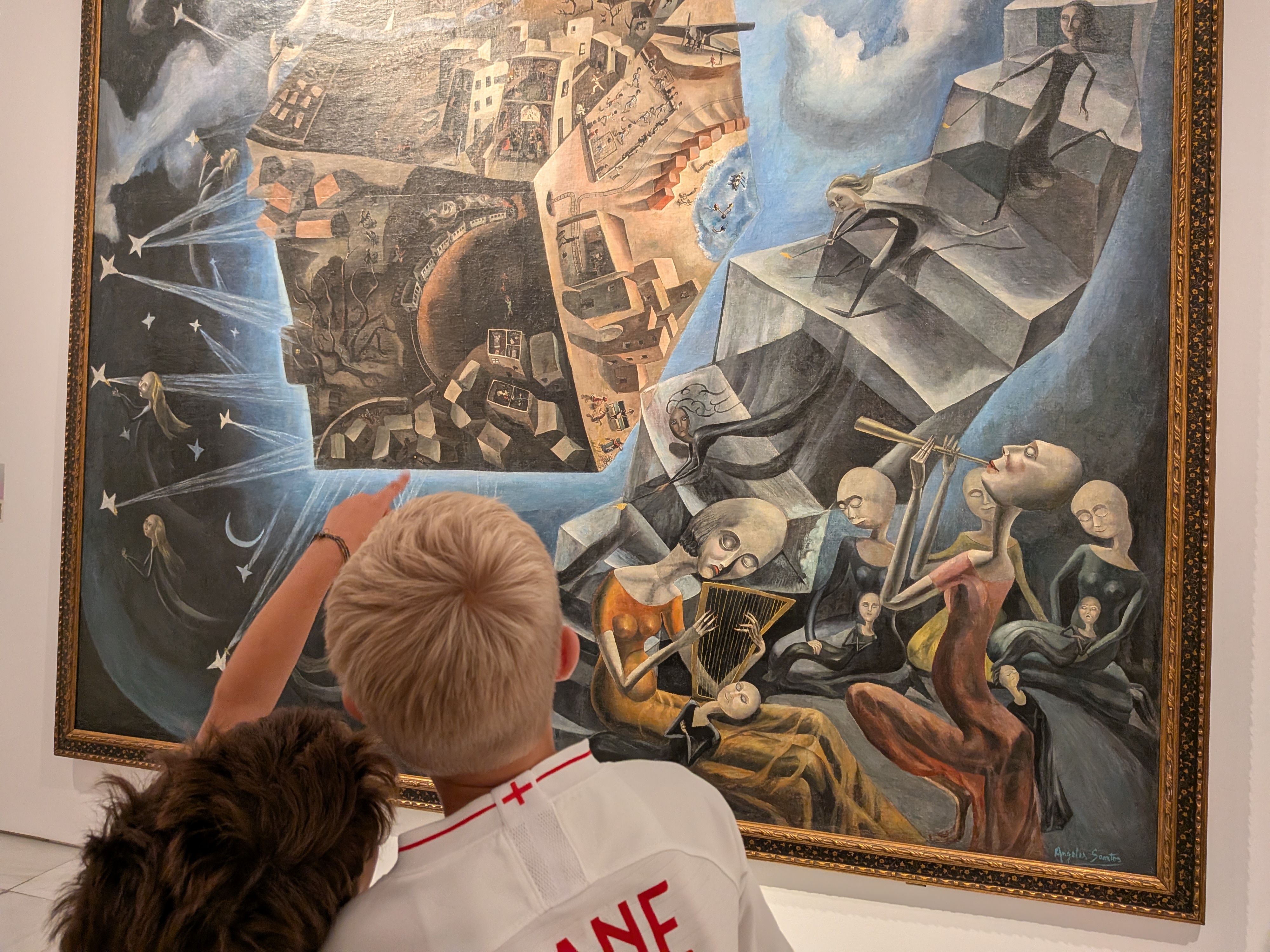
In the photo: two children who love Deep. Our next goal: 20 children who love it, then 100, then 1000. Let’s go! One child at a time.
As a parent of two children who go to primary school, I am worried about a few things: my kids’ addiction to screens, their natural curiosity slowly fading, and my limited ability to spend quality 1:1 time with them.
In the afternoon when I’m at home with my kids, as I need to finish my work and then prepare dinner, what would help me?
To be honest, I am not looking for more worksheets or more “school work”.
I am looking for something that would help keep my kids’ curiosity alive – and something they can do pretty much on their own, or with a friend, with limited support from me.
Curiosity is good – but curiosity about what, exactly?
Maria Montessori, one of the most important educators of the 20th century, describes the 6-12 year old child with an emerging reasoning mind and vivid imagination. Children in this phase of development begin to explore why and how the universe operates. They have an intellectual curiosity, and their natural interests are wide-ranging – from science to human history.
Which is why I would like my children to have the opportunity to explore a range of questions about the universe, nature and humans. What would happen if gravity suddenly changed? How do creatures survive deep in the ocean, where the sun never reaches? How did humans spread across the whole planet? How can you prove something is impossible?
At home, I imagine children using a digital workspace where they can work on meaningful projects, and complete them pretty much independently, or with a friend – with limited involvement from their parents. I mean active projects, where children can manipulate things, test ideas, build something, and use their creativity. Some of the projects may be on the screen, others may be completed physically, some may contain elements of both, digital and physical.
For example, here is a project: What lives in a single drop of pond water? A child turns their parent’s phone into a microscope, films a drop of water from a pond, a puddle or a vase, and looks for something that moves. Then they choose one of the creatures they found, learn more about it (using well-prepared digital resources), and make the first page of their own field guide. It takes about an hour, and the phone is mostly just a camera.
My co-founder Diego and I have been building Deep for the last few months. We have built an app where children can make amazing illustrated books worth reading over and over again. We envision that over time, Deep will evolve into a digital, creative workspace for curious 6-12 year olds, with projects like the one described above.
This does not exist yet. We have sketched out a few project ideas, but we will only build them if enough parents want it. If that sounds like what you are looking for, please join our waiting list at www.deep.ist/spark.
What does your child do after school when you’re at home with them, and what do you wish existed?


Leave a Reply